

How Dirty Is the Average American Home, Really? 🐝
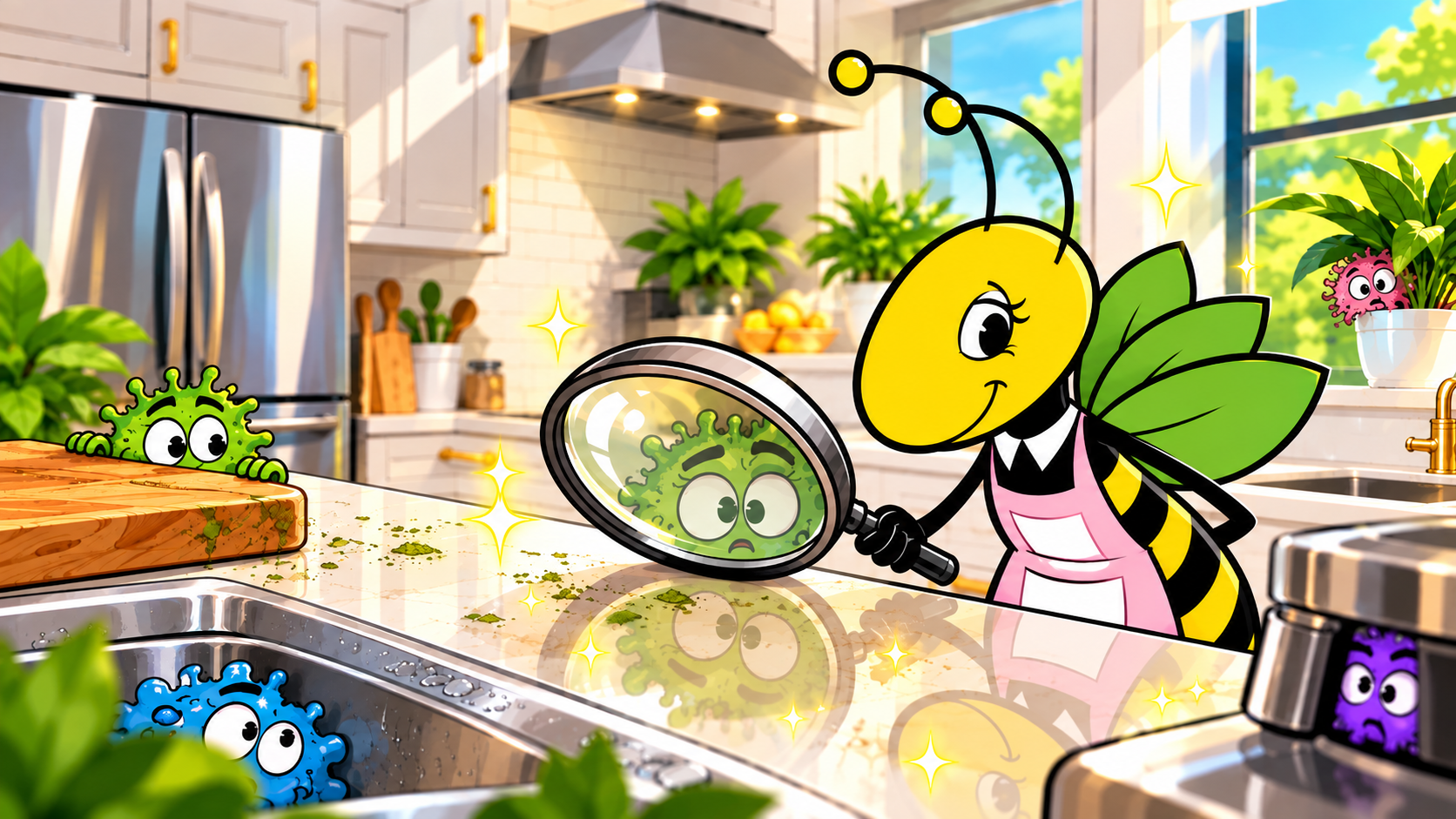
A clean-looking home can still have a few sneaky spots hiding in plain sight. 🐝
Let’s talk about the stuff hiding in your house that you probably don’t think about.
Your house looks clean.
The counters are wiped down. The floors have been vacuumed. The bathroom smells like whatever cleaning product you used last.
So...we're good, right?
Well, maybe.
Because when scientists actually start swabbing the things we touch every day, the results get pretty interesting. And sometimes a little gross.
The important thing to remember is that “dirty” doesn't always mean something looks dirty. A surface can look perfectly clean and still have bacteria, yeast, mold or other microorganisms hanging around.
And some of the biggest surprises aren't where you'd expect.
🧽Surprise #1: Your kitchen may be dirtier than your bathroom
Most people would probably put the bathroom at the top of the "grossest room in the house" list.
Scientists did too—until they started testing.
In a 2011 study, NSF International had 22 families swab 30 everyday household surfaces to look for things including yeast, mold and coliform bacteria. And the kitchen came out as the biggest microbial trouble spot.
In fact, NSF found coliform bacteria on:
More than 75% of kitchen sponges and dish rags
45% of kitchen sinks
32% of kitchen countertops
18% of cutting boards
Compare that with the bathroom, where coliform was found on 27% of toothbrush holders and 9% of bathroom faucet handles in the study.
Yep.
Your kitchen sponge—the thing you use to clean your kitchen—may actually be one of the nastiest things in it.
🦠 The places you don't think about are often the places worth thinking about
Here's another interesting thing about cleaning:
We tend to clean what we see.
Crumbs on the counter? Wipe them up.
Dirty floor? Vacuum it.
Spot on the mirror? Grab the glass cleaner.
But what about the area around the refrigerator handle?
The cabinet pulls?
The edge of the countertop?
The faucet handle?
The sink drain?
Those are the kinds of places that can get skipped during a quick clean.
And researchers have found that wet areas and frequently touched surfaces can be particularly good places for microorganisms to hang around. One study examining household surfaces found higher bacterial counts associated with wet sites such as tubs, kitchen sinks and faucet handles.
That's one reason a home can look clean without necessarily being thoroughly cleaned.
🍳 Your kitchen is basically a bacteria crossroads
Think about what happens in your kitchen on an average Tuesday.
You touch the refrigerator.
You grab raw chicken.
You open a cabinet.
You wash your hands.
You grab the faucet.
You chop vegetables.
You wipe the counter.
You pick up your phone.
You touch the refrigerator again.
Your kitchen gets a lot of traffic.
And research backs up the idea that kitchen surfaces can become contaminated through food preparation and everyday activity.
In a study of 100 Philadelphia-area home kitchens, researchers found fecal coliforms in 44% of homes, while E. coli was found in 15%. Nearly 45% of the homes tested positive for at least one foodborne pathogen.
Before anyone starts bleaching the entire house:
This doesn't mean 45% of American homes are dangerous.
It was a specific study of 100 homes in Philadelphia, not a nationwide survey. But it does show just how easily microorganisms can make their way onto ordinary kitchen surfaces.
🧹 So...does that mean your house is filthy?
Not necessarily.
And that's actually the point.
Homes are full of microorganisms. That's normal.
The goal isn't to create some laboratory-perfect, completely germ-free house. That's not realistic—and it's not necessary.
The interesting part is understanding where dirt, grime and microorganisms tend to accumulate, especially in the areas that don't get much attention during a regular cleaning.
That's where a deeper clean can make a difference.
The corners.
The edges.
The handles.
The buildup around fixtures.
The places behind and underneath things.
The areas you don't notice until someone actually points them out.
And that's where B gets busy. 🐝
At B's Eco-Clean, we're not just interested in making a home look clean.
We're interested in getting into the places that are easy to overlook.
Because sometimes the cleanest-looking house isn't necessarily the most thoroughly cleaned house.
And sometimes...
you just need to know where to look.
🔎 Want to geek out over the research?
Here are a few of the studies and sources behind this article:
NSF International — Germiest Items in the Home — The 22-family, 30-surface household study.
NSF International — 2011 Household Germ Study Executive Summary — The original study findings, including the 32% countertop figure.
PubMed — Household microbial hotspots study — Peer-reviewed research on microbial contamination in 22 households.
PubMed — Pathogens in 100 home kitchens — Research examining contamination and foodborne pathogens in Philadelphia-area home kitchens.
PubMed — Bacteria on commonly touched household surfaces — Research examining bacteria on household surfaces including sinks, tubs and faucet handles.